
How to Speak Sailmaker
A straight-talking guide to sailing terminology from the people who make the sails. Step aboard any sailing boat and you will quickly realise something strange: nothing is called what you expect. The kitchen is not a kitchen, the toilet is not a toilet, and “left” and “right” have mysteriously disappeared altogether. At Sanders Sails, we spend our lives designing, building, fitting, and trimming sails, which means we also spend a lot of time communicating clearly on boats; often in wind, noise, and pressure. The language sailors use is not tradition for tradition’s sake; it exists because clarity keeps boats efficient, safe, and fast. This is a no-nonsense guide to the sailing terms that actually matter.
Your Left and Right
On a boat, directions are fixed to the vessel – not the person.
- Port = left side when facing forward
- Starboard = right side when facing forward
Fun fact: You may have noticed that the tell-tales on our sails are red and green — and that is no accident. We use green tell-tales on starboard and red tell-tales on port, mirroring the familiar marine “traffic light” system. A yacht sailing on port tack must keep clear of a yacht on starboard, so spotting green is a subtle visual reminder that you have right of way over a vessel approaching on the opposite tack.
Your Front and Back
- Bow – the front of the boat
- Stern – the back of the boat
- Forward (fore) – moving toward the bow
- Aft – moving toward the stern
As sailmakers, we use these terms constantly; sail shapes, loads, reefing systems and covers all behave differently depending on where they sit fore or aft.
Relative to the Wind
These are sailing fundamentals:
- Windward – the side facing into the wind
- Leeward – the sheltered side, away from the wind
Understanding windward and leeward is the foundation of good sail trim, not just good vocabulary.
Yacht Structure
- Hull – the body of the boat that floats
- Deck – everything you walk on
From our perspective, deck layout matters hugely. Winch positions, traveller placement and sprayhood clearance all affect how sails are used — and how covers are designed.
Underwater Appendages
- Keel – the underwater fin that provides stability and grip
- Rudder – the steering blade at the stern
Together, they turn sail power into forward motion, which is why sail shape must always work with the underwater profile of the boat.
Types of Spars
- Mast – vertical spar holding the sails
- Boom – horizontal spar controlling the mainsail
The boom controls sail shape more than most people realise, which is why lazyjacks, stack packs and covers need to be designed around how the sail moves.
Types of Sail
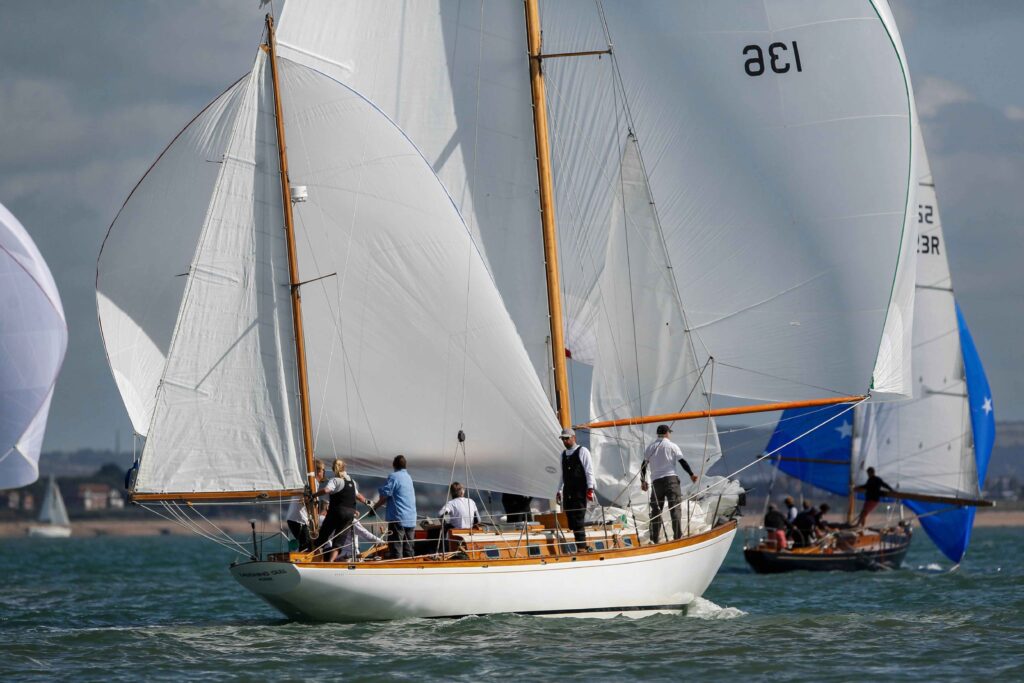
- Mainsail – The principal sail, usually set behind a mast
- Headsail – A forward sail set off the forestay
- Spinnaker – A large, lightweight sail flown downwind
- Mizzen – A smaller sail set on a second mast aft, used to improve balance
- Storm Jib – A small, heavily reinforced headsail designed severe weather
- Trysail – A compact, ultra-strong sail hoisted in place of the mainsail in severe conditions
There are many variations that build on these basic sail types, but understanding these terms will help you make sense of our emails and recommendations.
Running Rigging Components
- Halyards – raise sails
- Sheets – control their angle
- Winches – make heavy loads manageable
These are key controls to setting your sail correctly. Halyard tension can move draft fore and aft in the sail and sheets can get those tell tales trimming to perfection.
Parts of a Sail
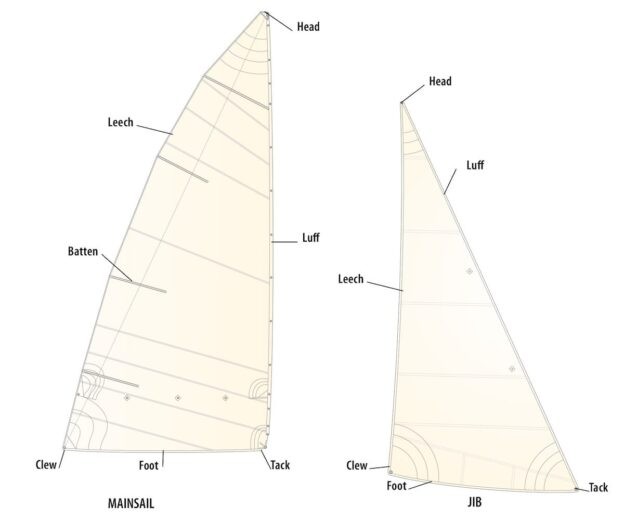
Now we are right in the heart of our field of expertise. Knowing the parts of the sail will be crucial to us understanding your feedback and the guidance we will be able to give you from our support team.
- Head – The top corner of the sail, attached to the halyard.
- Foot – The bottom edge of the sail, running along the boom or deck.
- Luff – The leading edge of the sail, closest to the mast or forestay.
- Leech – The trailing edge of the sail, opposite the luff.
- Tack – The forward bottom corner of the sail, where the luff and foot meet.
- Clew – The aft bottom corner of the sail, where the leech and foot meet.
- Roach – The curved area of sail that extends beyond a straight leech to add area.
- Battens – Flexible supports that help maintain sail shape and control flutter.